Category: Archaeology > Fortified Settlement
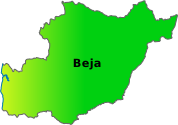
District: Beja > Almodôvar > Santa Clara-a-Nova
- Located near the village of Santa Clara-a-Nova, in the municipality of Almodôvar, Portugal.
- Founded during the Chalcolithic period and occupied in Roman and Islamic times.
- Ruins partially destroyed in 1986, leading to subsequent archaeological interventions.
- Situated in an isolated region, far from the coast, with natural defenses provided by rivers and ravines.
- Composed of two main platforms, one trapezoidal and the other circular, formed by walls.
- Occupies an area of approximately four hectares, with dimensions of 250 m in length and 100 m in width.
- Discoveries of artifacts such as ceramics, amphorae, Italian terra sigillata, and traces of bones and metal pieces.
- Classified as a Property of Public Interest in 1990.
- Vestiges indicate occupation from the Chalcolithic period to Islamic rule.
- Discovery of a funerary stele with an inscription in Southwestern Script.
- Account of a resident who claimed to have been visited by a woman who lived underground with a "lizard man".
- Belief that people lived in underground houses in Mesas do Castelinho, possibly related to the ruins below the ground.
- Originally a fortified settlement, part of the pre-Roman riverine settlements of the southwest region of the Iberian Peninsula.
- Three distinct phases of occupation; foundation and original occupation, contact with Roman civilization, and reuse of structures during Islamic rule.
- Referenced by José Leite de Vasconcelos in 1933 and described as "wall on a hill" and "walled city".
- In-depth studies initiated in 1948 and archaeological interventions since 1987.
- Excavations to discover the organization and periods of occupation, preserve important structures, and collect the archaeological spoils.
Sources: https://pt.wikipedia.org/wiki/Povoado_das_Mesas_do_Castelinho
Coordinates DD: 37.4846964,-8.1253551
Coordinates DMS: 37°29'4.9"N 08°07'31.3"W
 Weather Santa Clara-a-Nova


 On-duty Pharmacy Santa Clara-a-Nova