Category: Military Architecture > Wall
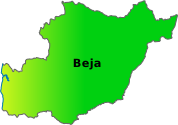
District: Beja > Serpa > Serpa > Bairro Municipal
- Located in the city of Serpa, in Baixo Alentejo, Portugal.
- It is part of the set of fortifications on the left bank of the Guadiana river.
- Classified as a National Monument in 1954.
- Prehistoric origin, later Romanized.
- Roman fortification existed to protect the region.
- It passed through the hands of the Alans, Vandals, Suevi, Visigoths, and Muslims.
- Reconquered by the Christians in the mid-12th century.
- Disputes with Castile and cession to D. Beatriz in the 13th century.
- Reconstruction and fortification during the reign of D. Dinis in the 14th century.
- Participation in the 1383-1385 crisis and support for D. João I.
- Royal concessions and strengthening under D. Manuel I.
- Fall to Spanish troops in 1580.
- Donated by D. João IV to Infante D. Pedro after the Restoration of Independence.
- Modernization works during the Restoration War.
- Damage caused during the War of the Spanish Succession.
- Process of deterioration and collapse over the centuries.
- Located in the historical center of Serpa.
- Alcáçova with a quadrangular plan on the highest level.
- Town walls with an oval shape, reinforced by barbicans and towers.
Moura Gate, Beja Gate and Seville Gate (disappeared).
- Aqueduct and noria for water supply.
- Keep, semicircular barbican and rectangular tower.
- Clock Tower, with bell function, transformed into a clock in the 15th century.
- Palace of the Counts of Ficalho, Mannerist style.
- Located in the Keep.
- Exhibition of artifacts from the Paleolithic, Neolithic, Metal Ages and Roman period.
Coordinates DD: 37.9446905,-7.5973714
Coordinates DMS: 37°56'40.9"N 07°35'50.5"W
 Weather Serpa



 On-duty Pharmacy Serpa